Our Vineyards Certified organic

Certified organic

Castelnuovo Berardenga, Siena, Tuscany

Our Place

Our Place
Our Place Tolaini Estate - Our Place

Castelnuovo Berardenga

Castelnuovo Berardenga, as defined by Alessandro Masnaghetti, is a diverse Chianti Classico region divided into two key sectors: the western sector with varied elevations and calcareous soils, and the eastern sector with higher elevations and distinct geological compositions. Castelnuovo Berardenga is renowned for its very warm climate, which contributes to its distinctive wines. These wines are characterized by a bold taste profile, featuring notes of eucalyptus, balsamic, and rich, structured fruit. 

Chianti Classico is governed by strict regulations to preserve its ecosystem: only a portion of land may be planted to vines or olives, while the rest must remain as natural woodland. Vineyard plantings are further regulated, with minimum densities of 4,000 vines per hectare and strict yield.

MELLO/Gaiole is grown at roughly 700 meters (2200 ft) above sea level and is the highest altitude vineyard in the entire Chianti Classico DOCG. Mello was planted by renowned agronomist Ruggero Mazzilli and is also a certified organic vineyard.

This terroir boasts warm sunny days, cool nights and a constant breeze, ideal for Sangiovese. The soil is Macigno, a well-draining non-calcareous sandstone soil, poor in organic matter, which imparts finesse and elegance to this Cru's Sangiovese.  

This unique balance of agriculture and nature is fundamental to both sustainability and the identity of Chianti Classico wines.
The Chianti Classico Consortium recently redefined the region’s map into 11 UGAs (Unità Geografiche Aggiuntive) to better reflect the unique terroirs of Chianti Classico. While some UGAs align with historic communes like Gaiole, Radda, and Castellina, others—such as Lamole, Montefioralle, Panzano, and Vagliagli—represent distinct subzones within larger communes. Tolaini, though geographically within the newly formed Vagliagli UGA, has chosen to label its wines under the Castelnuovo Berardenga UGA to remain aligned with the style, structure, and identity that have always defined our vineyards and winemaking philosophy.

Castelnuovo Berardenga

Organic Farming & Sustainability

Organic Farming & Sustainability
Organic Farming & Sustainability Caring for Our Terroir

Caring for Our Terroir

We began practicing organic farming in 2013, guided by a deep respect for the land and a belief that great wine begins in a healthy vineyard. In 2023, our commitment was formally recognized with official organic certification, which means the 2023 vintage will be our first certified organic release.
Over the past decade, we’ve witnessed a remarkable transformation: the vineyards are more vibrant, balanced, and full of life. With organic farming, biodiversity thrives. Beneficial insects have returned, the soil is richer in micronutrients, and the vines are free to follow their natural rhythms—unlocking a deeper expression of our terroir.
This shift in the vineyard has slowly allowed us to change our approach in the cellar as well. The grapes arrive bursting with natural character and require less intervention during vinification.

Tannins are softer, flavors are more layered, and the expression of each vineyard site shines through. Our single-vineyard approach embraces the unique mix of altitude, soil and microclimate. Working organically allows us to listen more closely to the vines and adapt to what each vintage—and each plant—asks of us. No force, just a respectful partnership with nature.

Sustainability is about balance—giving back as much as we take. We work in sync with our vineyards, using cover crops to retain water and reduce erosion, collecting rainwater for irrigation, and harnessing solar energy, ensuring minimal environmental impact. As a result, we are proud to be carbon-negative.. 

In the Vineyard

In the Vineyard
In the Vineyard Great wines begin in the vineyard

Great wines begin in the vineyard

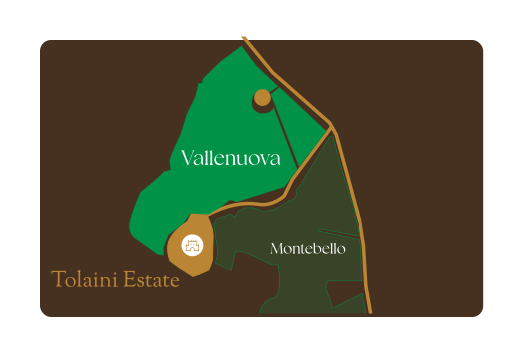
Located in the southernmost point of Chianti Classico, Tolaini estate covers 110 hectares (270 acres), with 50 hectares (125 acres) dedicated to vineyards thoughtfully positioned to maximize each site’s natural potential. About half of our vines are nestled in a natural amphitheater surrounding the Montebello villa and Vallenuova cantina, while the other half are 3 kilometers (1.86 miles) away in the San Giovanni vineyards.
Planted between 300 and 450 meters (1,000–1,500 feet) above sea level, our vineyards benefit from a pronounced diurnal temperature variation—warm, sunlit days followed by cool nights. This climate nuance preserves acidity, enhances aromatics, and lends structure and finesse to each wine.

Our vineyards were planted in 2000 after an extensive zonation study analyzing soil type, drainage, sun exposure, and microclimate. As a result, the estate was divided into 24 distinct parcels, each matched to the grape variety best suited to its environment. In certain vintages, these parcels are further subdivided into two or three micro-blocks, allowing for even greater precision in expression.

Our philosophy is simple but unwavering: great wine begins in the vineyard. By cultivating exceptional fruit, we craft wines that are a true reflection of the unique terroir of Castelnuovo Berardenga—one of Chianti Classico’s most distinguished subzones. 

Our Soils

Our Soils
Our Soils Our Soils

At Tolaini, the soul of our wines begins in the soil—a remarkable mosaic that defines the unique character of each vineyard site. Across our estate, we are privileged to have a diverse range of soils, from the limestone-rich formations of Alberese and the compact clays of Silano, to well-draining sandy parcels. This geological diversity, even within a single vineyard, allows us to craft eight distinctive wines, each a precise expression of its origin.

Vallenuova

In the Vallenuova vineyard, deep clay soils layered with limestone provide ideal conditions for Sangiovese, producing wines of structure and purity.

Vallenuova image
Vallenuova carte

This extraordinary range of terroirs not only allows us to match grape variety to ideal growing conditions, but also to reveal subtle nuances in fruit grown mere meters apart.